


By Ticha Denis Kruger | BootCamp Facilitator
Isingiro Secondary School, Uganda | 28 July 2026
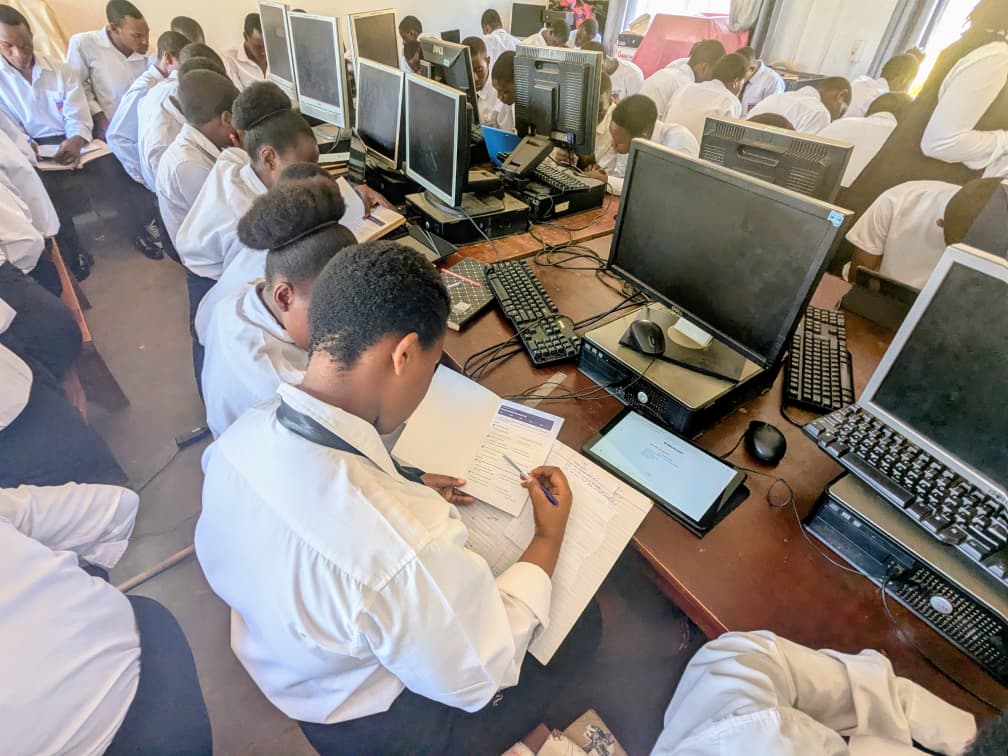
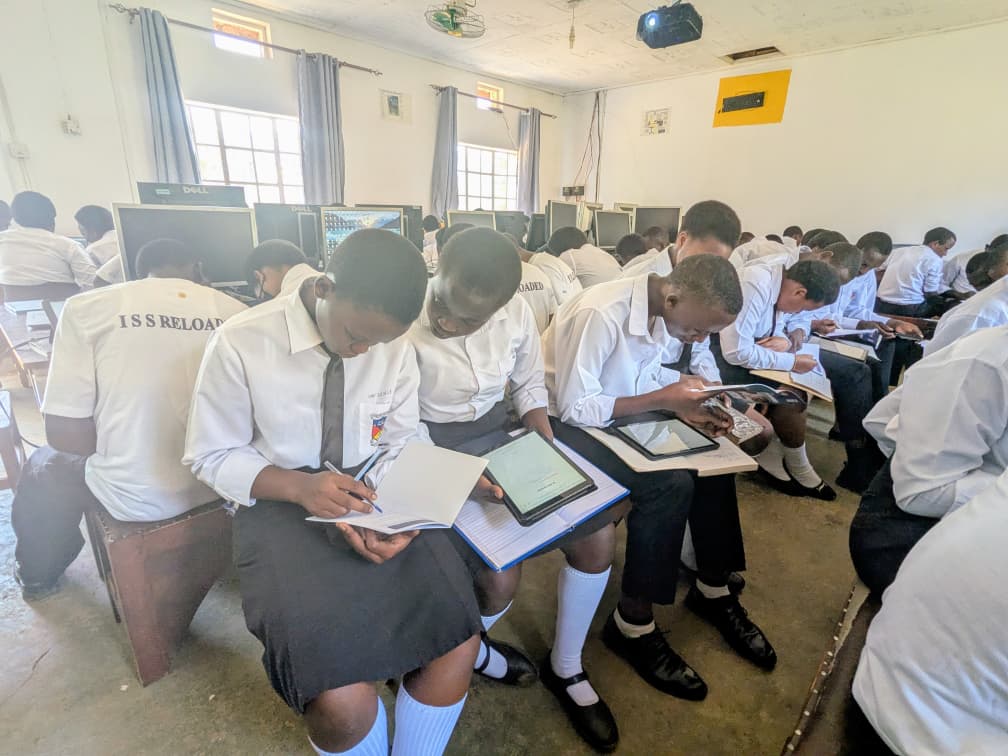
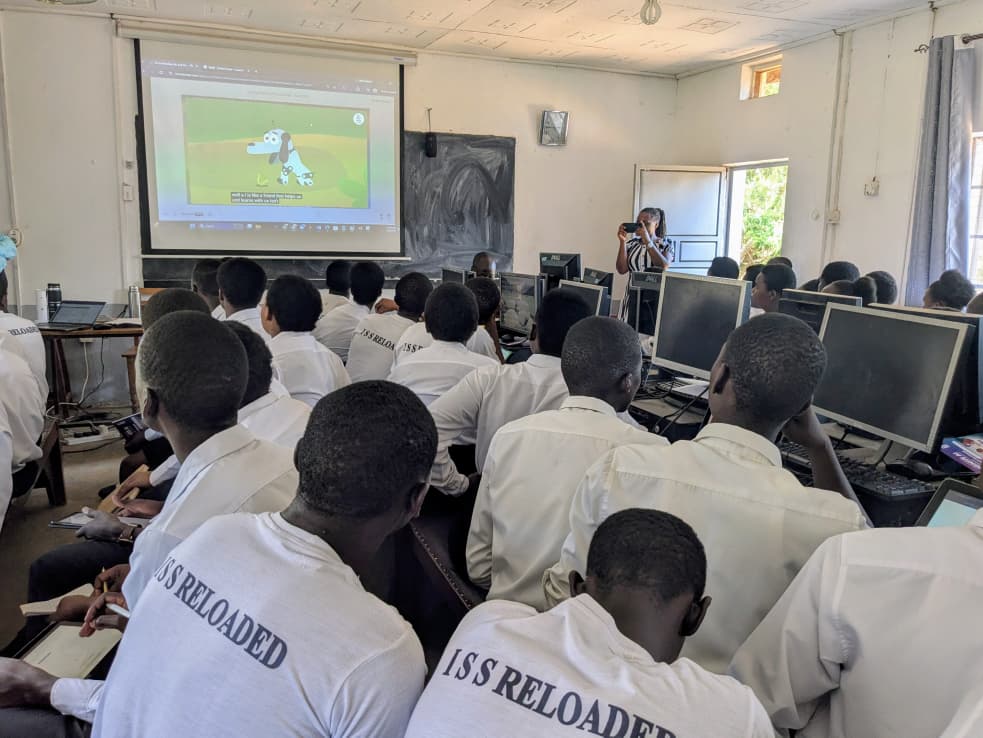
On 28th July 2026, I had the privilege of serving as BootCamp Facilitator at Isingiro Secondary School, where my colleague Arinda Shiphura, Technical Coach, and I were deployed by Refactory Uganda to deliver the “Ignite AI: Skills for the AI Era” AI Literacy Bootcamp. By the end of the day, we had trained more than 130 learners from Senior One, Senior Two, Senior Three and Senior Five through a series of carefully managed shifts. The experience was more than a technology lesson: it was an invitation for young people to become thoughtful users, critical questioners and responsible innovators in an increasingly AI-enabled world.


Meeting Learners at Their Level
Artificial intelligence is often discussed using distant, highly technical language. Our task was to make it practical, relatable and useful to a Ugandan secondary-school learner. We therefore began with familiar experiences: face unlock on a phone, YouTube and music recommendations, word suggestions while typing, Google Maps, ordinary calculators and alarm clocks. These examples helped learners distinguish systems that may use AI from ordinary digital tools that simply follow fixed instructions.
The central message was deliberately balanced: AI can learn patterns from data, recognise information, make predictions or suggestions, and generate text, images, speech and code; however, it is not magic, it is not always correct, and it does not remove the need for human responsibility. Young people should see AI as an assistant that can extend their abilities, not as a substitute for curiosity, effort, character or judgment.
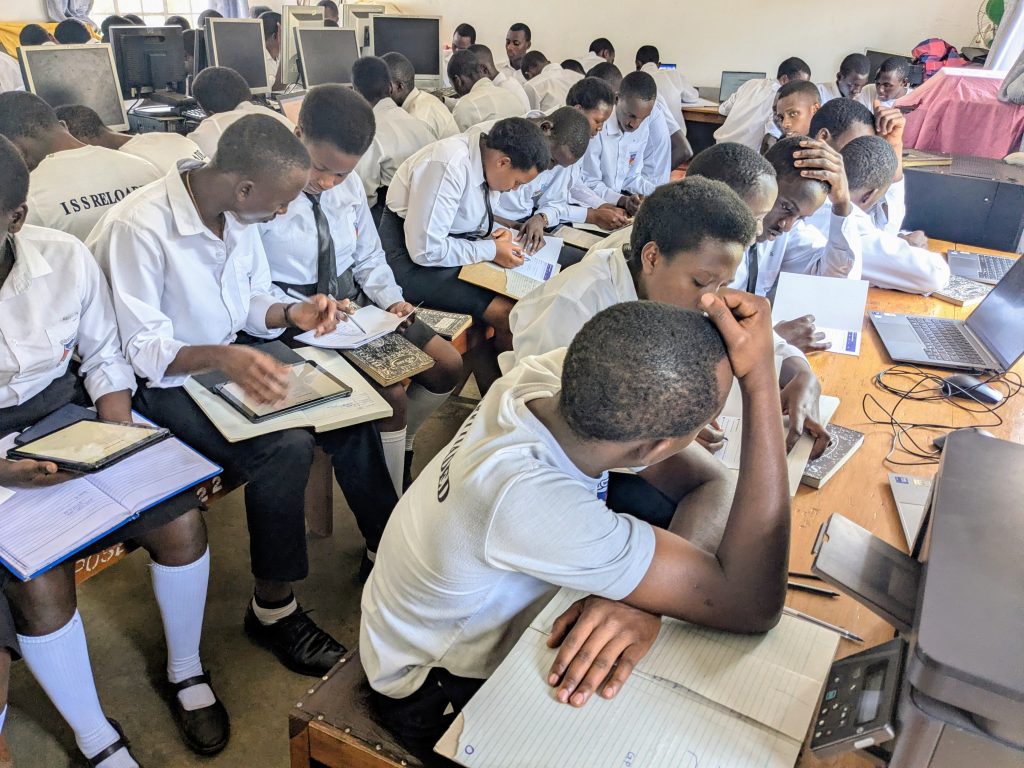
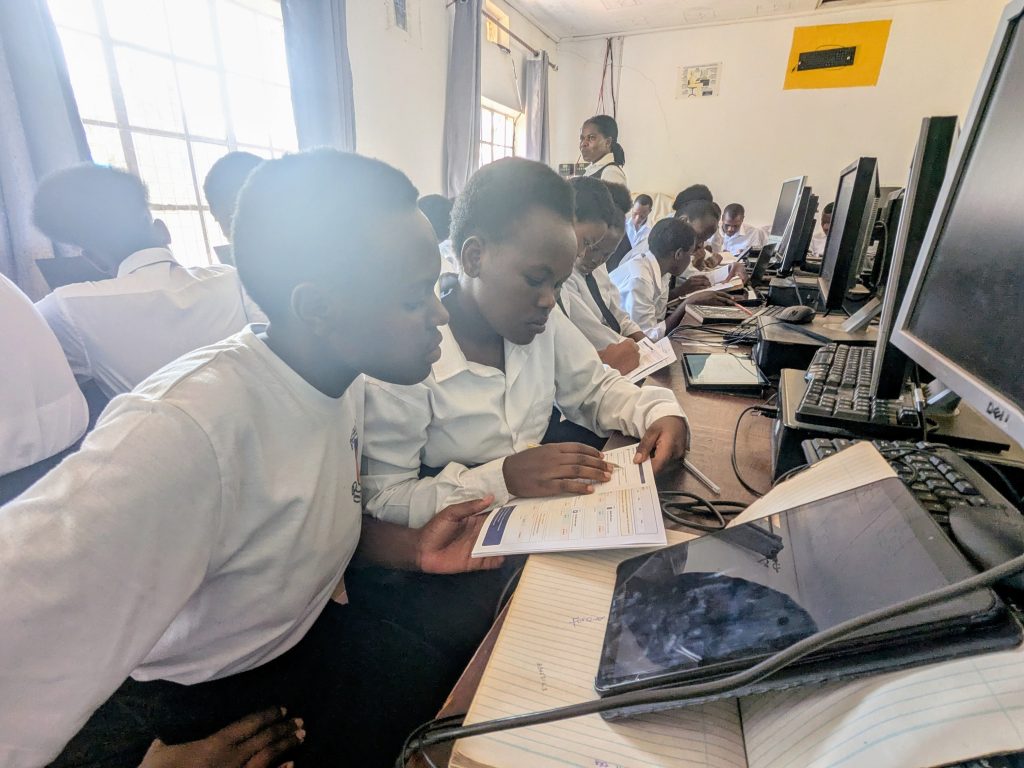
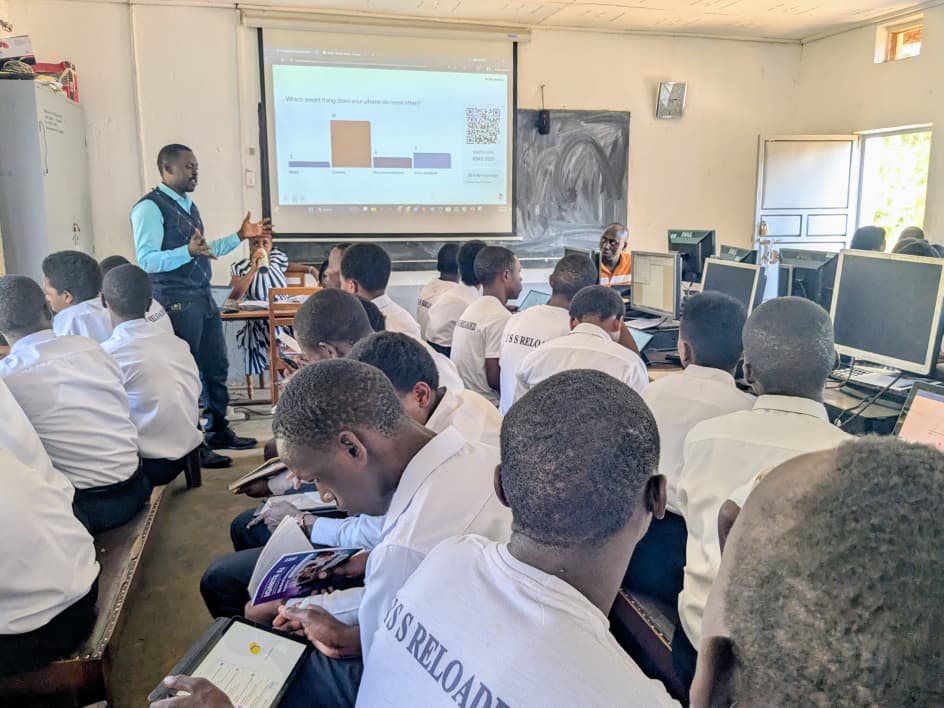
Learners debate whether familiar digital tools use artificial intelligence, strengthening their ability to question technology rather than accept every claim.
Learning Through Participation, Not Passive Listening
Because the participating classes ranged from Senior One to Senior Five, we delivered the training in different shifts and adjusted the depth of discussion while preserving the same learning journey. Younger learners benefited from familiar examples, voting, drawing and guided practice. Older learners were challenged to think more deeply about training data, bias, accountability, privacy and the consequences of using AI in decisions that affect people.
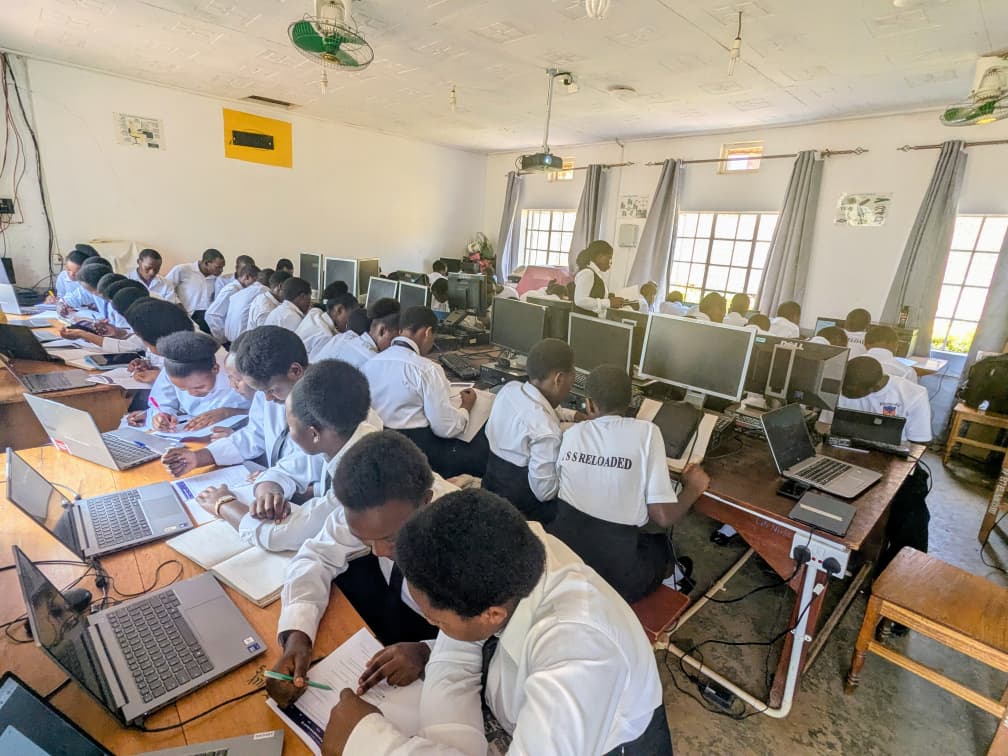
The sessions were intentionally interactive. Learners answered questions, worked through practical scenarios, compared weak and strong prompts, discussed responsible and irresponsible uses of AI, and considered problems in their own school and communities. This approach was important because AI literacy cannot be developed through definitions alone. Learners need opportunities to practise, make mistakes, explain their reasoning and improve their ideas.
From Vague Requests to Effective Prompts
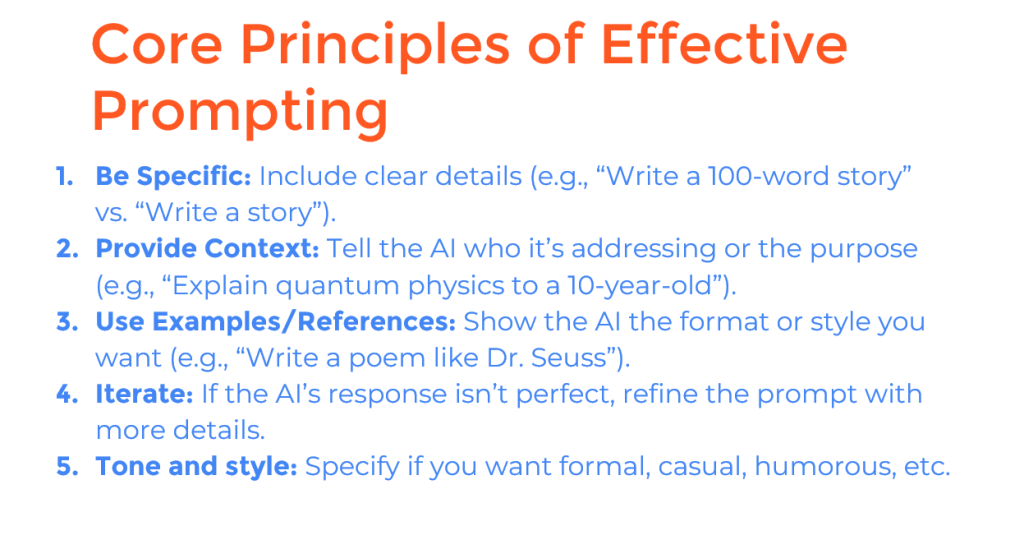
One of the most important skills we demonstrated was prompt writing. A prompt is the instruction or question a person gives to a generative AI tool. Learners quickly saw that the same tool can produce very different results depending on the clarity of the instruction. A vague prompt such as “Teach me algebra” provides little information about the learner, the difficulty, the expected explanation or the desired output. A stronger prompt might say: “I am a Senior Two learner who is struggling with linear equations. Explain the method step by step using simple English, show one worked example, and then give me five practice questions. Do not show the answers until I attempt them.”
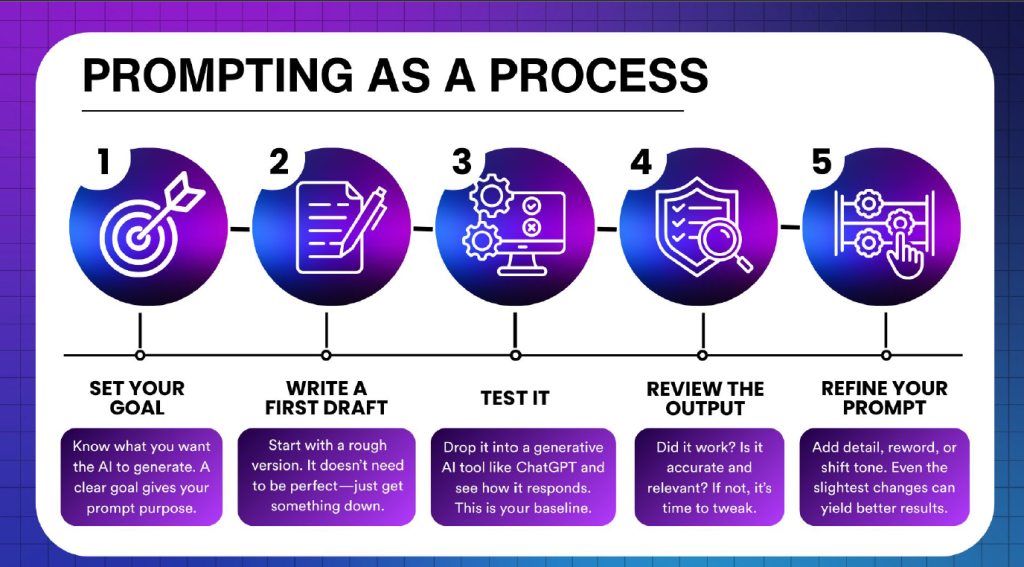
We taught learners to include a clear goal, relevant context, the intended audience, useful details, the preferred format and necessary limits. They also learnt that prompting is an iterative process. If an answer is too broad, too difficult or inaccurate, the responsible response is not to copy it blindly; it is to inspect the output, improve the instruction, ask follow-up questions and verify important facts.
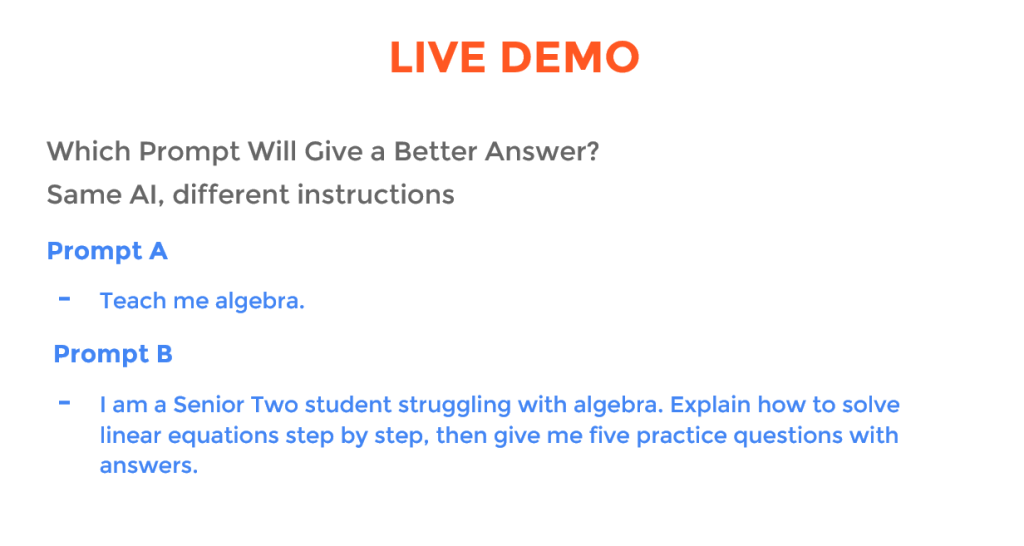
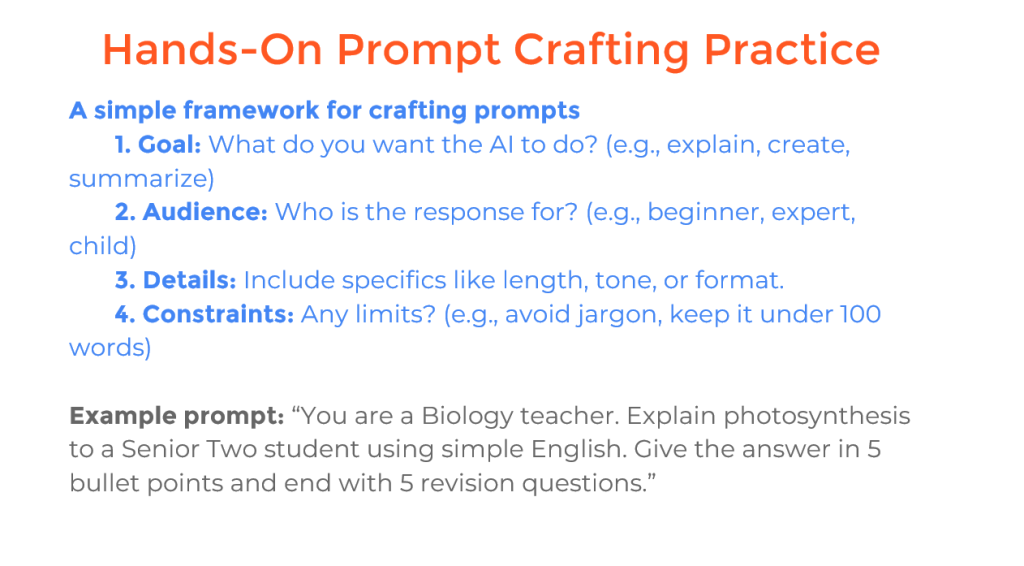
Poor prompt:
Give me maths questions.
Better prompt:
Create five S3 mathematics questions on simultaneous equations. Begin with an easy question and gradually increase the difficulty. Do not provide solutions until I have attempted all five. When I submit my answers, give hints before showing complete solutions.
A Practical Guide to Using AI Effectively
The lessons shared at Isingiro Secondary School can be summarised in a practical discipline for any learner. First, define the real task before opening an AI tool. Ask whether you need an explanation, revision questions, feedback, an outline, a summary, a story, an image or ideas for a project. A tool is most useful when the user is clear about the purpose.
Second, provide context. A learner should identify the subject, class level, local setting and intended reader. “Explain photosynthesis” is broad; “Explain photosynthesis to a Senior Two learner in Uganda using simple English, five bullet points and three revision questions” is much more useful. Context helps AI produce an answer that better fits the learner’s actual need.
Third, protect the learning process. AI should help a learner understand, practise, brainstorm, plan and receive feedback. It should not become a hidden replacement for the learner’s own work. Copying an unverified AI-generated assignment may produce incorrect information and denies the learner the opportunity to develop competence. A responsible learner attempts the work, asks for hints or feedback, checks the response against a textbook or teacher, and then expresses the final answer in their own understanding.
Fourth, verify before trusting or sharing. Generative AI can produce fluent and confident statements that are incomplete, outdated or false. Names, dates, statistics, laws, quotations, scientific claims and health information deserve particular scrutiny. Learners should compare important claims with textbooks, teachers, qualified professionals, official websites or other reliable sources. AI should never be the only authority used to confirm its own answer.
Fifth, protect personal data. Learners were reminded not to enter passwords, PINs, one-time codes, Mobile Money details, private photographs, home addresses, live locations, medical information or another person’s confidential information into unknown applications. Uganda’s Data Protection and Privacy Act, 2019 reinforces the importance of understanding what information is collected, why it is requested, who can access it and whether it is truly necessary to share.
Sixth, use generated media responsibly. A realistic AI-generated image or video is not proof that an event happened. Before forwarding emotional or shocking content, a responsible user pauses, looks for the original source and checks trusted reporting. AI should never be used to humiliate classmates, impersonate another person, create deceptive evidence or damage someone’s reputation.
Finally, keep a human responsible. AI may assist a farmer to identify patterns on a crop, help a learner create revision questions, support a vendor to draft a customer message or help a health worker screen information. It should not make high-stakes decisions without competent human review. The person using the system must consider context, fairness, safety and the consequences of error.
Connecting AI to Ugandan Opportunities
The training linked AI to sectors that learners recognise. In agriculture, AI-enabled tools can help identify crop diseases and analyse farm conditions. In health, carefully governed systems can support the screening and interpretation of information while qualified professionals remain responsible for diagnosis and care. In transport, AI can support navigation and traffic management. In education, it can generate practice questions, explain concepts at different levels and provide feedback. In business, it can help entrepreneurs draft messages, organise information and communicate with customers.
We were equally careful to discuss access and inclusion. A solution that works only for people with expensive smartphones, constant internet access or advanced English may exclude the very community it is intended to serve. Effective innovation in Uganda must consider shared devices, offline alternatives, local languages, disability access, cost and the knowledge of people who understand the community.
Responsible AI, Bias and Human Judgment
A significant part of the bootcamp focused on ethics. Learners explored how an AI system can repeat unfair patterns when it learns from historical or incomplete data. If past records reflect exclusion, the system may reproduce that exclusion even though a machine does not possess human intentions or emotions. This is why fairness requires relevant criteria, diverse evidence, testing across different groups, transparent explanations, meaningful human review and a way for affected people to challenge a decision.
We also discussed the future of work. AI will change how many tasks are performed, but the future will require more than technical speed. Curiosity enables people to ask better questions; creativity helps them imagine alternatives; care enables them to understand other people; local knowledge grounds solutions in reality; and judgment helps them make responsible decisions when an answer is uncertain. These are not secondary skills. They are the qualities that allow a person to direct technology wisely.


From Users to Innovators
The innovation component invited learners to move beyond consuming AI services and begin thinking like problem-solvers. They considered challenges affecting learning, agriculture, health communication, business, transport, clean water and community wellbeing. The guiding question was not, “Can AI solve everything?” It was, “Which specific part of this problem could AI help people address?”
A responsible innovation begins with a clearly identified person and problem. It defines the limited task AI will perform, the information the system requires, the person who will check its output, the harm that could occur if it is wrong, and the alternative available when internet access or the system itself fails. It must also ask who could be excluded and how the design can become more accessible. This problem-first approach is essential if young innovators are to create solutions that are not only impressive, but genuinely useful and safe.
Using Pre- and Post-Assessment to Support Learning
Participants completed an assessment before the session and again at the end through the programme’s pre- and post-assessment tool. The exercise established what learners understood before the training and provided evidence for reviewing immediate learning after the session. The assessment can be accessed at https://bit.ly/refactoryaiquizz. Because the response data still requires analysis, this article does not claim a specific score improvement; the responsible next step is to examine the collected results and report verified findings.
Assessment was presented as a learning tool rather than a source of anxiety. Learners were encouraged to answer honestly, reflect on their progress and recognise that AI literacy develops through continued practice. The most meaningful outcome is not merely remembering a definition, but demonstrating safer choices, clearer prompts, stronger verification habits and a more thoughtful approach to innovation.
A Day Worth Remembering
Training more than 130 learners across four class levels in a single day demanded coordination, adaptability and energy. Yet the scale of the exercise also demonstrated the appetite young people have for practical digital knowledge when it is connected to their lives. The certificate and group-photo moment provided a fitting conclusion: a celebration not only of attendance, but of the responsibility that comes with new knowledge.
For Arinda Shiphura and me, the day reaffirmed that meaningful AI education should leave learners with both confidence and caution. They should feel capable of using AI to learn, create and solve problems, while remaining alert to error, unfairness, privacy risks and misinformation. Technology becomes valuable when people apply it with purpose, evidence and care.
Appreciation to Refactory Uganda
I extend my sincere appreciation to Refactory Uganda for entrusting us with the opportunity to serve as facilitators in this important initiative. Refactory’s commitment to practical technology education is helping extend AI literacy beyond specialist spaces and into the hands of secondary-school learners who can use it to strengthen learning, problem-solving and innovation. Being deployed to Isingiro Secondary School was both a professional responsibility and a personal honour. I am grateful for the planning, learning resources and confidence placed in our team. Learn more about Refactory at Refactory Uganda.
A Vote of Thanks to UNDP
I also offer a special vote of thanks to the United Nations Development Programme for supporting the National AI Literacy Programme and investing in opportunities that help young people participate meaningfully in the digital future. Expanding responsible AI knowledge among learners strengthens more than technical ability: it contributes to inclusive innovation, informed citizenship and the capacity of communities to develop solutions grounded in their own realities. Learn more about UNDP’s work in Uganda at UNDP Uganda.
Looking Ahead
The work of building AI literacy does not end when certificates are issued or when the final assessment is submitted. Learners need continued opportunities to practise writing prompts, verify information, discuss ethical dilemmas and develop solutions to real school and community challenges. Schools, families, technology organisations and development partners all have a role in creating safe environments for that learning.
My message to the learners of Isingiro Secondary School is simple: remain curious, but do not surrender your judgment. Use AI to ask better questions, deepen your understanding, create responsibly and serve your community. The future of AI in Uganda will not be shaped by technology alone. It will be shaped by young people who understand both what these tools can do and what responsible human beings must still decide.


Mr. Wilfred Mukulembeze handing over a certificate of Appreciation to Mr. Ssekasamba Gerald, BootCamp Teacher Champion who doubles as a Host ICT Teacher for Isingiro Secondary School.
Written by Ticha Denis Kruger, BootCamp Facilitator. Training delivered with Arinda Shiphura, Technical Coach, following deployment by Refactory Uganda.



(1) Comment
Thank you for this well-structured account of the Ignite AI Literacy Bootcamp at Isingiro Secondary School. The practical approach—grounding AI in everyday tools, teaching effective prompting, stressing verification, privacy and ethics, and linking the technology to local challenges—offers a model of responsible digital education. Equipping more than 130 learners with both skill and judgment is a meaningful contribution to Uganda’s AI future.