Artificial intelligence is rapidly changing education. Teachers are using AI tools to prepare lesson plans, create learning materials, develop assessments, simplify difficult concepts and improve classroom activities. Learners are also using the same tools to conduct research, understand challenging topics and complete assignments.
These developments offer important opportunities for education. However, they also raise serious questions about academic honesty and genuine learning.
As an ICT teacher and EduTech facilitator, I have interacted with educators who are excited about the possibilities of artificial intelligence but are equally concerned about its misuse. One question appears repeatedly in discussions with teachers:
“How can I know whether a learner wrote an assignment independently or asked artificial intelligence to write it?”
This is not an easy question to answer.
A learner can enter an assignment question into ChatGPT, Gemini, Microsoft Copilot or another generative AI tool and receive a polished response within seconds. The answer may include an introduction, organised arguments, relevant examples, references and a conclusion. In some cases, the language may appear stronger than anything the learner has previously submitted.
A teacher reading such an assignment may naturally become suspicious. However, suspicion is not proof. A polished assignment may have been generated by AI, carefully researched by the learner, improved through legitimate support or revised using a grammar tool.
The truth is that teachers can sometimes identify signs of possible AI assistance, but they cannot always prove AI use by examining the final document alone. AI-detection tools may provide useful indicators, but their results should not be treated as final evidence of academic misconduct.
The most important question is therefore not simply whether AI was involved. A better question is whether the learner understands, owns and can explain the work that was submitted.
My reflection as an educator
For many years, an assignment represented a visible learning process. A learner received a question, consulted class notes or textbooks, organised ideas, prepared a draft and submitted the final work. Although copying and plagiarism existed, the assignment still required the learner to participate in several stages of research and writing.
Generative AI has changed this process.
A learner can now move directly from receiving an assignment question to producing a complete response. The learner may copy the generated answer without reading it carefully, checking the facts or understanding the ideas. The final document may look excellent even when very little learning has taken place.
This is what concerns me most.
The main problem is not simply that a learner has used technology. AI can support learning when it is used to explain difficult concepts, suggest revision questions, provide feedback or help a learner organise ideas. The problem begins when technology replaces the thinking, research, practice and reflection that an assignment was designed to develop.
As educators, we should avoid reducing this discussion to a simple conflict between teachers and artificial intelligence. Our responsibility is not to fight technology. Our responsibility is to protect meaningful learning.
This requires us to move beyond asking, “Did AI write this assignment?” We should also ask whether the learner understands the content, can explain the main ideas, can verify the information and can apply the knowledge in a different situation.
This change in focus can help teachers respond more fairly and effectively.
Not every use of AI is cheating
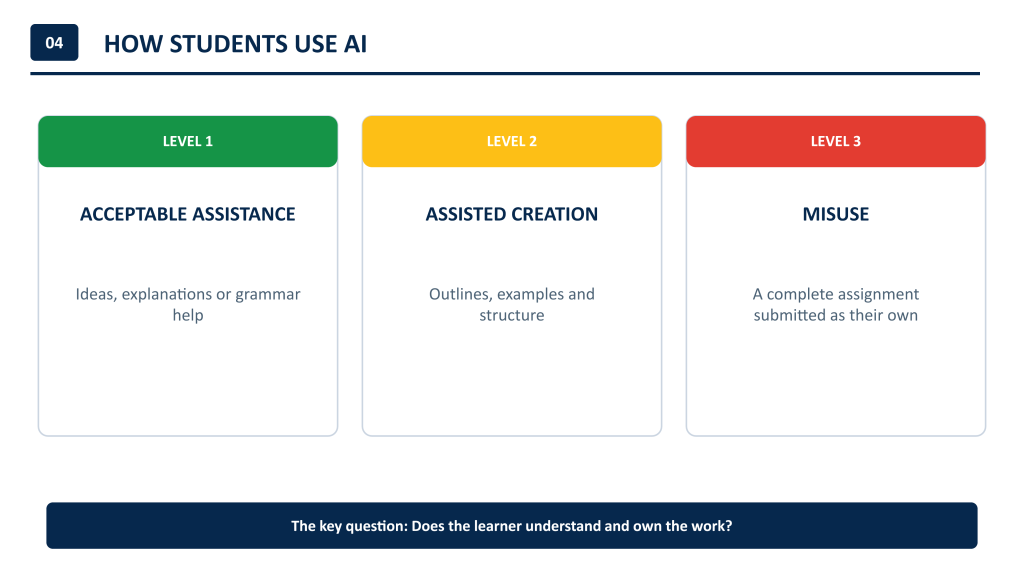
It is important to recognise that learners can use AI in different ways. Not every form of AI assistance should automatically be classified as academic dishonesty.
A learner may use AI as a learning assistant. For example, an S.2 learner who is struggling to understand photosynthesis might ask an AI tool to explain the concept in language suitable for a Senior Two learner. The learner may then compare the explanation with class notes and write an independent response.
In this case, AI has supported understanding. It has not necessarily replaced the learner’s work.
Another learner might ask AI to suggest an outline for an essay about the effects of climate change in Uganda. The learner could use the outline as a starting point, conduct further research and write the paragraphs independently. AI has influenced the structure, but the learner may still have completed most of the intellectual work.
The situation is different when a learner enters the complete assignment instructions and asks AI to produce the final response. The learner may use a prompt such as:
“Write this assignment for me. Use academic language, add references and make it look like it was written by a secondary-school student.”
If the learner copies the response and submits it without understanding it, AI has replaced the learning process. The assignment no longer provides reliable evidence of the learner’s knowledge or ability.
Teachers and schools should distinguish between these different levels of AI use. They should clearly explain which forms of assistance are acceptable, which are restricted and which must be disclosed.
Learners cannot follow expectations that have never been explained to them.
Why AI-generated writing is difficult to detect
AI detection is sometimes compared with plagiarism detection, but the two processes are different.
A plagiarism checker compares a learner’s writing with existing sources. These sources may include websites, books, journal articles and previously submitted documents. When matching passages are identified, the teacher can examine the original source and compare it with the learner’s work.
An AI detector normally does not have an original source to display. Generative AI creates new combinations of words rather than copying one complete document from a known publication.
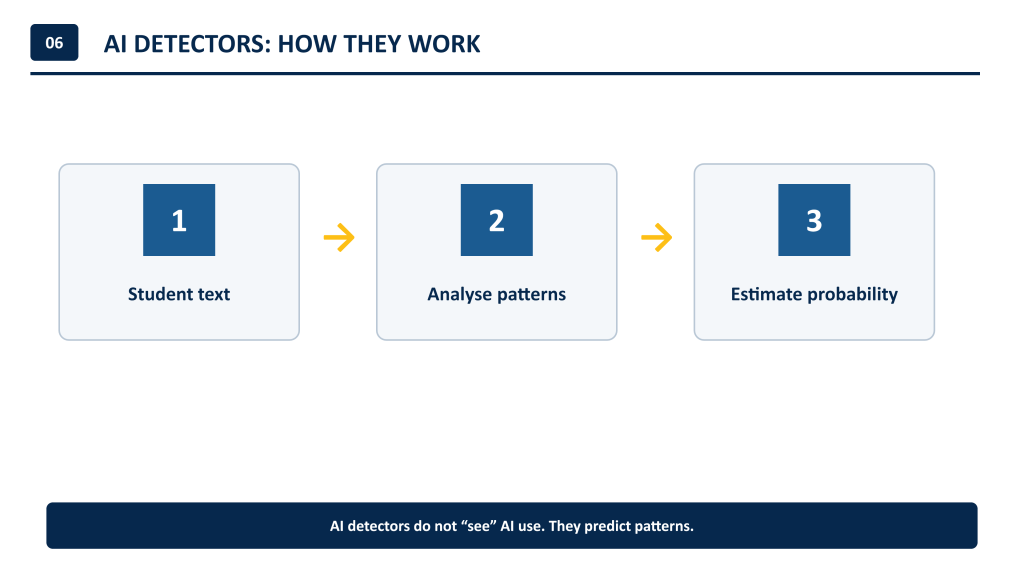
Instead, an AI detector analyses patterns in the writing. It may examine vocabulary, sentence variation, word predictability, paragraph structure and the frequency of certain language patterns. It then estimates the likelihood that the text was produced by an AI system.
The result is therefore a prediction.
The detector did not observe the learner completing the assignment. It does not know whether the learner used ChatGPT, received help from another person, consulted a textbook, used a grammar tool or revised the work carefully.
It only analyses the final text.
This means that a result such as “80% likely to be AI-generated” should not be interpreted as proof that AI completed 80% of the assignment. It is a probability estimate produced by the detection system according to its own model and criteria.
AI-detection tools can make two important types of mistakes. A false positive occurs when human-written work is incorrectly classified as AI-generated. A false negative occurs when AI-generated writing is classified as human-written.
Both mistakes are serious. A false positive may result in an innocent learner being unfairly accused. A false negative may allow inappropriate AI use to go unnoticed.
OpenAI previously introduced a tool for classifying AI-written text but later withdrew it because of its low accuracy. The company’s official notice demonstrates how difficult reliable AI detection can be.
Research published in the International Journal for Educational Integrity has also identified false positives, false negatives and inconsistent results among AI-detection tools. The researchers warned against using these tools as the sole evidence of academic misconduct. The study is available here.
This does not mean that detectors have no value. A detector may alert a teacher that an assignment requires further investigation. However, the detector should begin the investigation rather than determine the final decision.
Why fairness is especially important in Uganda
The limitations of AI detectors are particularly relevant in Uganda because many learners use English as a second or additional language.
A learner may use formal and predictable sentence structures because that is how academic English has been taught. The learner may rely on familiar expressions, straightforward vocabulary and carefully memorised grammatical patterns. These characteristics do not prove that AI was used.
Some AI detectors may interpret predictable writing as machine-generated. This creates a risk that learners who are still developing English-language confidence could be unfairly accused.
Researchers associated with Stanford University examined the performance of AI detectors on essays written by non-native English speakers. According to Stanford’s summary of the research, more than half of the examined TOEFL essays were misclassified as AI-generated by the tested detectors.
This finding should concern educators working in multilingual classrooms.
In Uganda, learners also have unequal access to technology. Some have personal smartphones, reliable internet connections and experience using several AI platforms. Others depend on shared family devices, school computer laboratories or occasional access to mobile data.
We should not assume that every learner has equal access to AI. We should also not assume that every polished assignment was generated by technology.
Fair assessment requires teachers to consider the learner, the context, the task and several forms of evidence before reaching a conclusion.
A sudden change in writing style
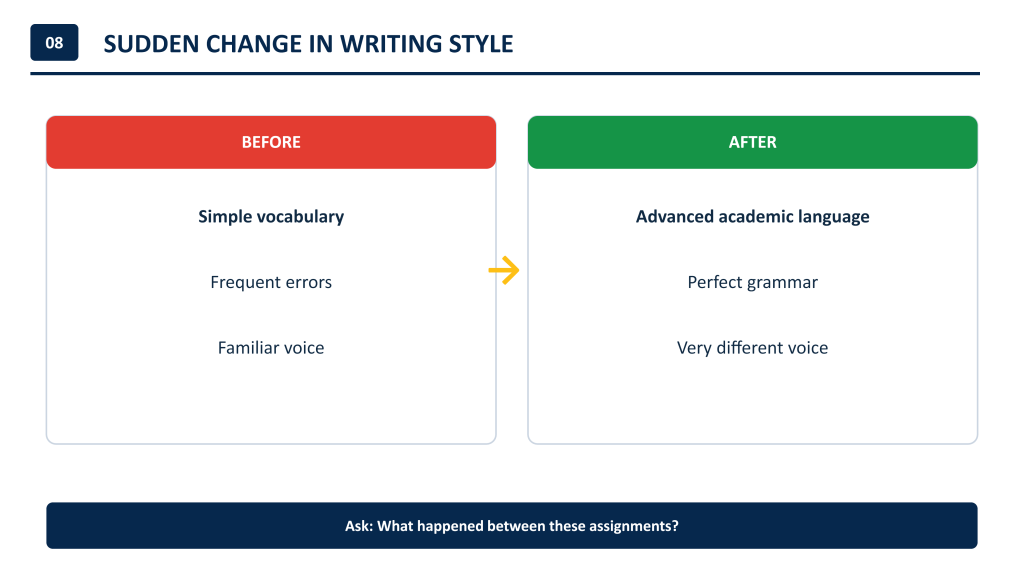
One warning sign may be a sudden change in a learner’s writing style.
Imagine an S.3 learner who normally writes short sentences using familiar vocabulary. The learner submits a Geography assignment containing the following sentence:
“Rapid urbanisation exacerbates environmental degradation through inadequate waste-management infrastructure and uncontrolled settlement expansion.”
The difference between this sentence and the learner’s previous writing is noticeable. However, it would be unfair for the teacher to conclude immediately that the assignment was generated by AI.
There may be other explanations. The learner may have received tutoring, consulted a new source, obtained assistance from a family member, used a grammar-support tool or spent more time revising than usual. The learner may also be making genuine progress.
The teacher should approach the situation with curiosity rather than accusation.
A fair response would be:
“I have noticed that the language in this assignment is different from your previous work. Please explain this sentence in your own words and tell me how you developed the paragraph.”
The learner’s response becomes part of the evidence.
Teachers should avoid saying, “This is too good to be your work.” Such a statement may discourage genuine improvement and damage trust between the teacher and learner.
When a learner cannot explain the assignment
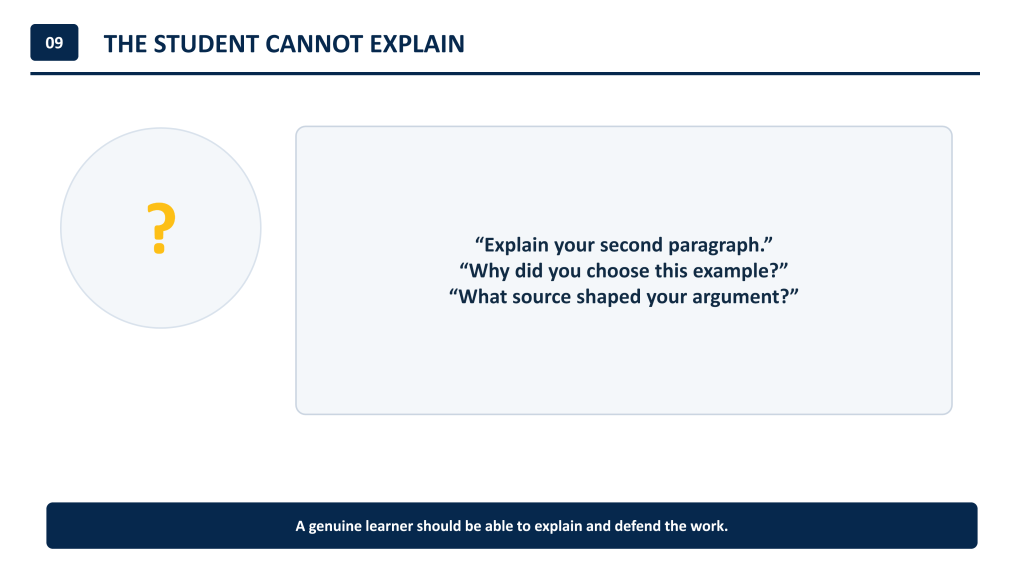
Another warning sign appears when a learner submits excellent work but cannot explain its central ideas.
Consider an S.5 learner who submits an impressive essay about youth unemployment in Uganda. The essay discusses structural unemployment, the informal sector, entrepreneurship and government policy. During a conversation, however, the learner cannot explain the meaning of structural unemployment or why the informal sector was included.
The learner also cannot identify the source behind a major claim.
This mismatch deserves further investigation. However, the teacher should not immediately ask, “Did ChatGPT write this?”
A better approach would be to say:
“Your assignment contains some interesting ideas. Please explain the main argument in your own words and show me how you developed it.”
The teacher can ask which part of the assignment was most difficult, which source influenced the argument, why a particular example was selected and what was changed during revision.
A learner who understands and owns the work should normally be able to discuss its central ideas. The explanation does not need to be perfect, but it should show meaningful engagement with the content.
Teachers must still consider nervousness, language ability and different communication needs. Difficulty speaking should not automatically be treated as proof of academic misconduct.
Oral verification should be a learning conversation, not an interrogation.
Generic examples and missing local context
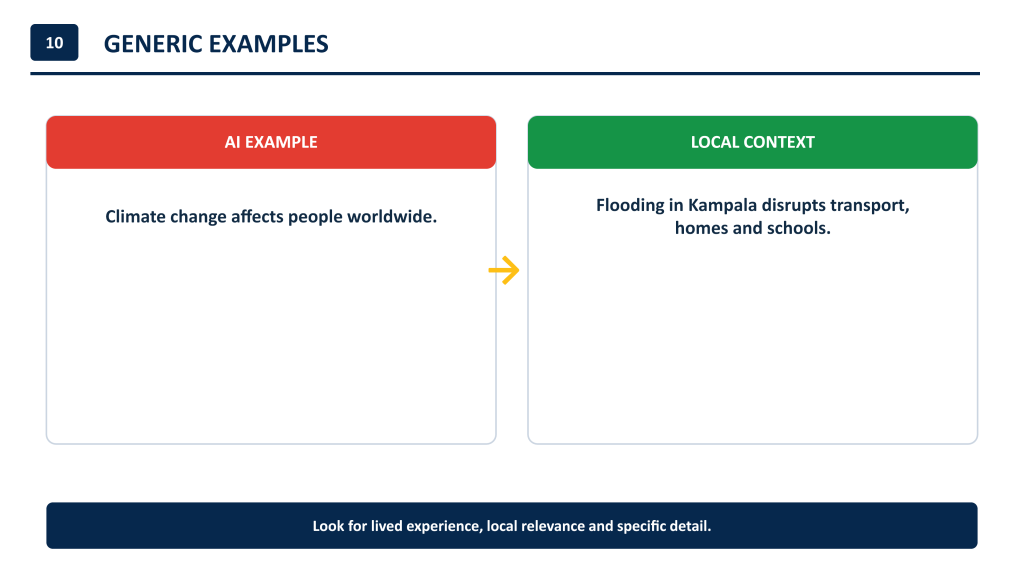
AI-generated responses often begin with general information unless the user requests a specific context.
Suppose learners are asked to explain the effects of climate change in Uganda. One learner submits an assignment that focuses entirely on hurricanes, snowstorms and examples from North America.
The information may be generally accurate, but it does not respond effectively to the Ugandan context.
A stronger assignment might discuss irregular rainfall, changes in planting seasons, prolonged dry periods, water access, livestock, flooding and transport disruption. The examples should be connected to locations and experiences that the learner can explain.
The teacher might ask:
“How does this example apply to Uganda?”
The teacher could also ask the learner to connect the issue to something observed in the local community or reported by a reliable Ugandan source.
However, local examples are not proof of human authorship. Modern AI systems can produce information about Kampala, Mbarara, Gulu, Jinja or another Ugandan location when prompted to do so.
The stronger test is whether the learner can verify, explain and apply the example.
False or unverifiable references
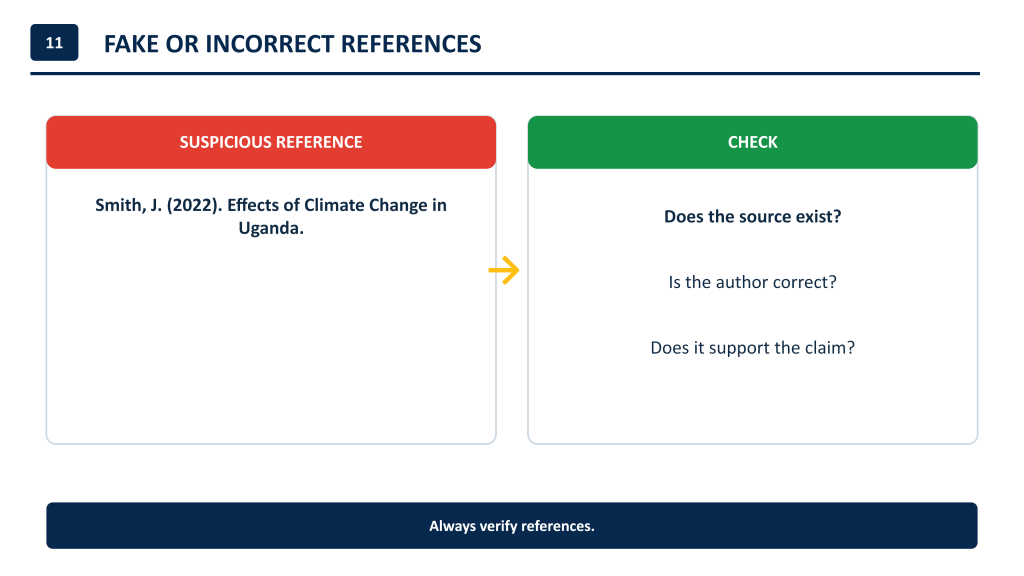
Generative AI tools can produce references that look convincing but do not exist.
Consider the following fictional statement:
“According to Okello and Namusoke (2023), 82% of Ugandan secondary-school learners use artificial intelligence every day.”
The learner’s reference list includes:
Okello, J. and Namusoke, P. (2023). Artificial Intelligence in Every Ugandan Classroom. Kampala Digital Education Press.
The reference looks believable. It contains authors, a year, a title and a publisher. However, the teacher should verify whether the publication exists.
The teacher should ask where the percentage came from, whether the authors are correct and whether the source supports the claim. The learner should be able to locate the publication or provide a working link.
If the reference cannot be found, the assignment contains a serious academic problem. However, the false reference still does not reveal exactly how the error occurred. The learner may have used AI, copied from another unreliable source or misunderstood how references should be prepared.
The teacher should investigate before deciding.
This also presents an important teaching opportunity. Learners should be taught that a reference is not included simply to make an assignment look academic. A reference must allow another person to locate and examine the source.
When writing appears too perfect
Teachers may also become suspicious when an assignment appears unusually organised.
AI-generated essays often contain a clear introduction, balanced body paragraphs, smooth transitions and a polished conclusion. However, these are also the features teachers encourage learners to include.
We should not punish learners for following the structures we have taught them.
A well-organised assignment should only become a concern when the structure is combined with other evidence. For example, the learner may be unable to explain the argument, the references may not exist and the writing may be completely different from previous classroom work.
Perfect structure alone is not proof.
The stronger questions are whether the ideas are accurate, relevant, properly supported and understood by the learner.
A practical demonstration for teachers
During a teacher-training session, one useful activity is to generate an assignment in real time.
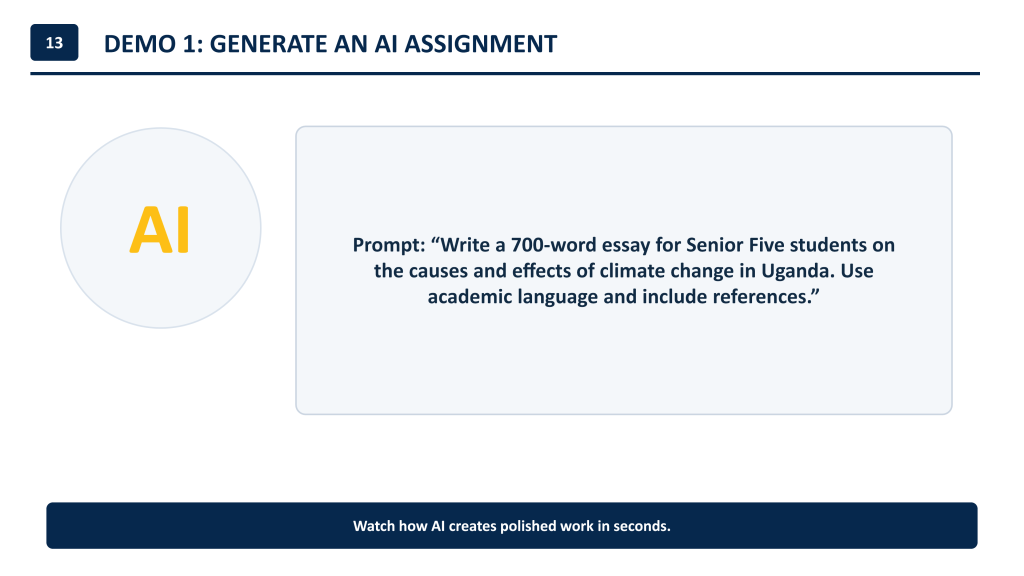
The facilitator can open ChatGPT or another generative AI tool and enter the following prompt:
“Write a 700-word essay for Senior Five students on the causes and effects of climate change in Uganda. Use academic language and include references.”
The tool will probably produce a structured essay within seconds.
Teachers can then examine the response. They can check whether the introduction is polished, whether the examples are relevant, whether the references can be verified and whether the response contains genuine personal experience.
The facilitator can then enter a second prompt:
“Rewrite the essay using examples from Kampala. Include personal reflection and local challenges.”
The second response may appear more local and authentic.
This demonstration shows that AI can imitate many of the features teachers might normally associate with genuine student writing. It can generate local examples, personal-sounding reflection and a less formal style.
Surface features will therefore become less useful as proof.
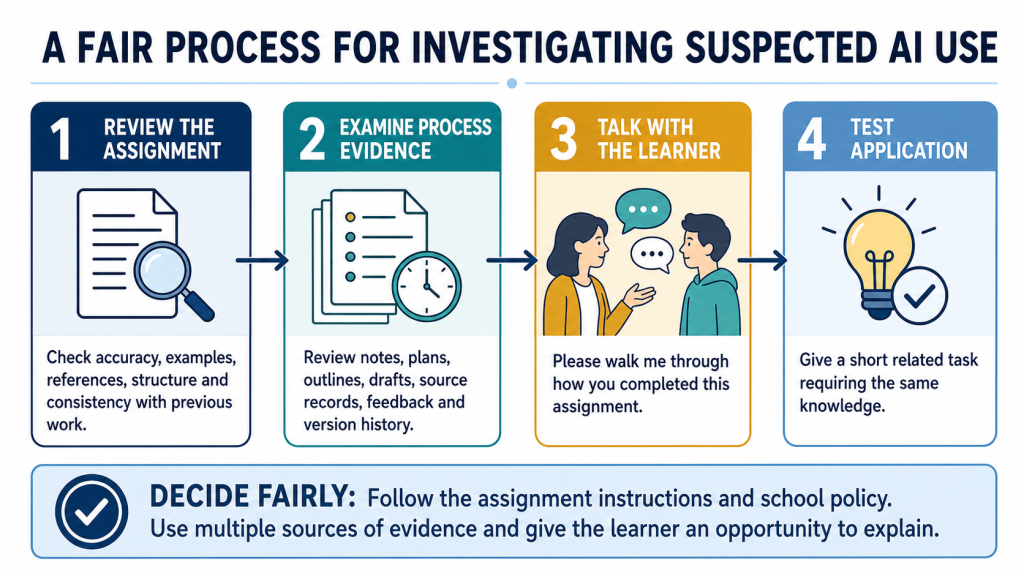
A fair process for investigating suspected AI use
When a teacher suspects inappropriate AI use, the response should be calm and evidence-based.
The first stage is to review the assignment. The teacher should examine its accuracy, examples, references, structure and consistency with previous work.
The second stage is to examine process evidence. This may include research notes, planning documents, outlines, early drafts, source records, teacher feedback, calculations, practical observations and document version history.
Process evidence is useful because the final assignment only shows the finished product. Notes and drafts reveal how the learner developed the work.
The third stage is a conversation with the learner. The teacher can begin by saying:
“Please walk me through how you completed this assignment.”
The learner can then explain which part was written first, which sources were consulted, what was changed during revision and whether any digital tools were used.
The fourth stage is application. The teacher can give the learner a short related task that requires the same knowledge.
A Mathematics learner can solve a similar problem and explain each step. A Biology learner can predict what would happen if one experimental condition changed. A Literature learner can interpret another passage. An ICT learner can demonstrate the process described in the assignment.
Application often provides stronger evidence of understanding than a detector percentage.
The final decision should be based on the assignment instructions, the school’s policy and multiple sources of evidence. The learner should be given a fair opportunity to explain the work before disciplinary action is considered.
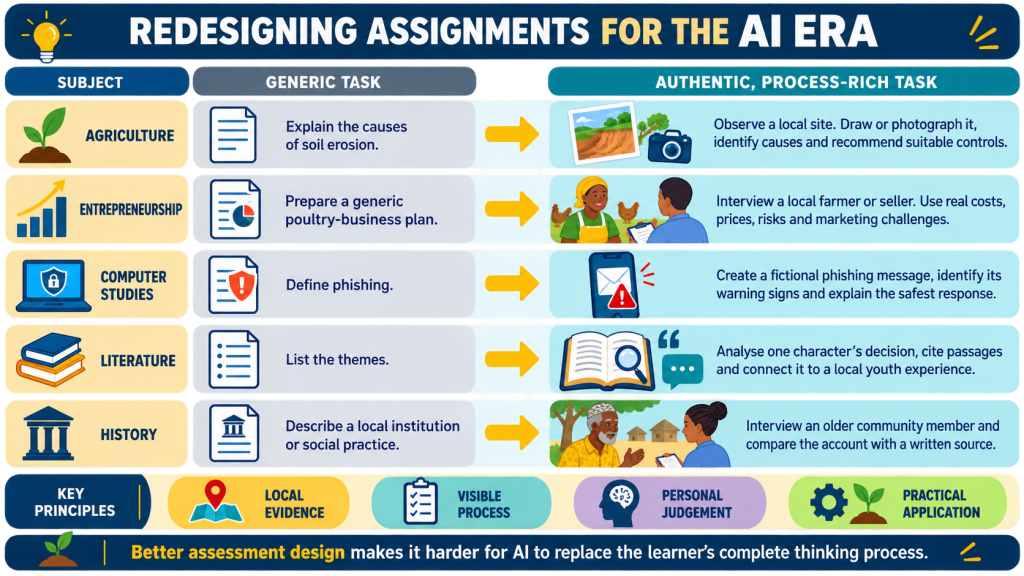
Redesigning assignments for the AI era
The strongest response to generative AI is not simply better detection. It is better assessment design.
Teachers should create assignments that require local evidence, visible process, personal judgement and practical application.
In Agriculture, instead of asking learners to explain the causes of soil erosion, a teacher can ask them to observe an affected area near the school or home. The learner can draw or photograph the area, identify possible causes and recommend practical control measures suitable for that location.
AI may explain soil erosion, but it cannot replace the learner’s direct observation.
In Entrepreneurship, instead of asking learners to prepare a generic poultry-business plan, the teacher can require them to interview a local poultry farmer or seller. The learner identifies operating costs, risks, prices and marketing challenges before preparing the proposal.
The teacher can then ask how prices were estimated, which cost was unexpected and what would happen if the cost of feed increased.
In Computer Studies, instead of asking learners only to define phishing, the teacher can ask them to create a fictional WhatsApp message demonstrating a phishing attempt. The learner must identify warning signs and explain the safest response.
In Literature, instead of asking learners to list themes, the teacher can ask them to select one character’s decision, cite relevant passages and connect the decision to a situation young people may encounter in their community.
In History, learners can interview an older community member about a local institution, economic activity or social practice and compare the interview with a written source.
These assignments do not make AI use impossible. They make it more difficult for AI to replace the learner’s complete thinking process.
Assess the learning process
One principle I continue to emphasise in my work with teachers is that we should not assess only the final document.
The final assignment should be part of a wider learning process. The teacher can review topic selection, research notes, planning, drafts, feedback, revision and reflection.
This approach gives teachers opportunities to guide learners before the final submission. It also creates evidence of genuine development.
Process-based assessment does not require expensive technology. In schools with limited digital access, learners can submit handwritten notes, source lists, drawings, observation tables, interview records and early drafts.
The principle is to make learning visible.
Teach responsible AI use
I do not believe that simply telling learners never to use AI will fully prepare them for the future.
Artificial intelligence is becoming part of education, employment, communication and content creation. Learners need to understand how to use it responsibly.
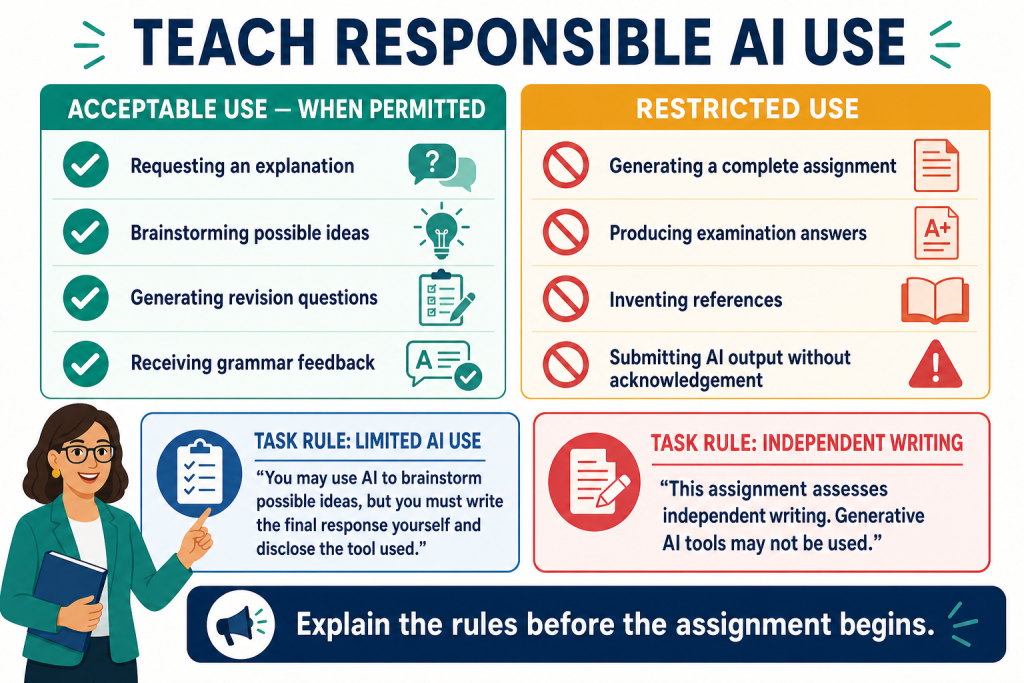
Depending on the assignment, acceptable use might include requesting an explanation, brainstorming possible ideas, generating revision questions or receiving grammar feedback.
Restricted use might include generating a complete assignment, producing examination answers, inventing references or submitting AI output without acknowledgement.
Teachers should explain the rules before the assignment begins.
One task might state:
“You may use AI to brainstorm possible ideas, but you must write the final response yourself and disclose the tool used.”
Another task might state:
“This assignment assesses independent writing. Generative AI tools may not be used.”
Clear instructions make expectations easier to follow and enforcement fairer.
Require meaningful disclosure
Where AI use is permitted, learners should be taught how to disclose it.
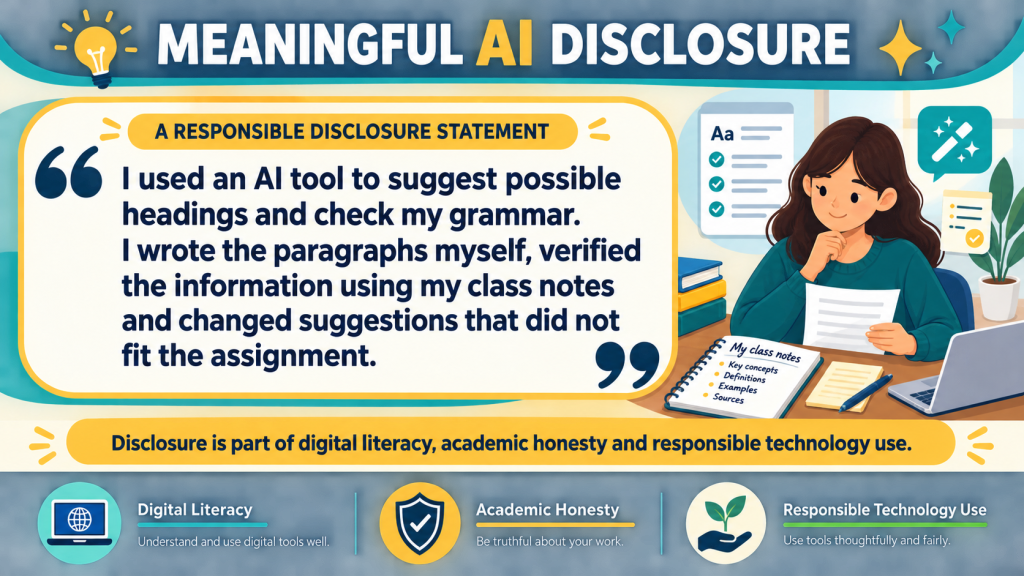
A learner should not simply write, “I used AI.”
A more useful statement would be:
“I used an AI tool to suggest possible headings and check my grammar. I wrote the paragraphs myself, verified the information using my class notes and changed suggestions that did not fit the assignment.”
This statement explains what the tool did and how the learner remained responsible for the final work.
Disclosure should not be treated only as a confession. It should be taught as part of digital literacy, academic honesty and responsible technology use.
Developing a school AI policy
Ugandan schools should not wait for serious cases to occur before deciding how to respond.
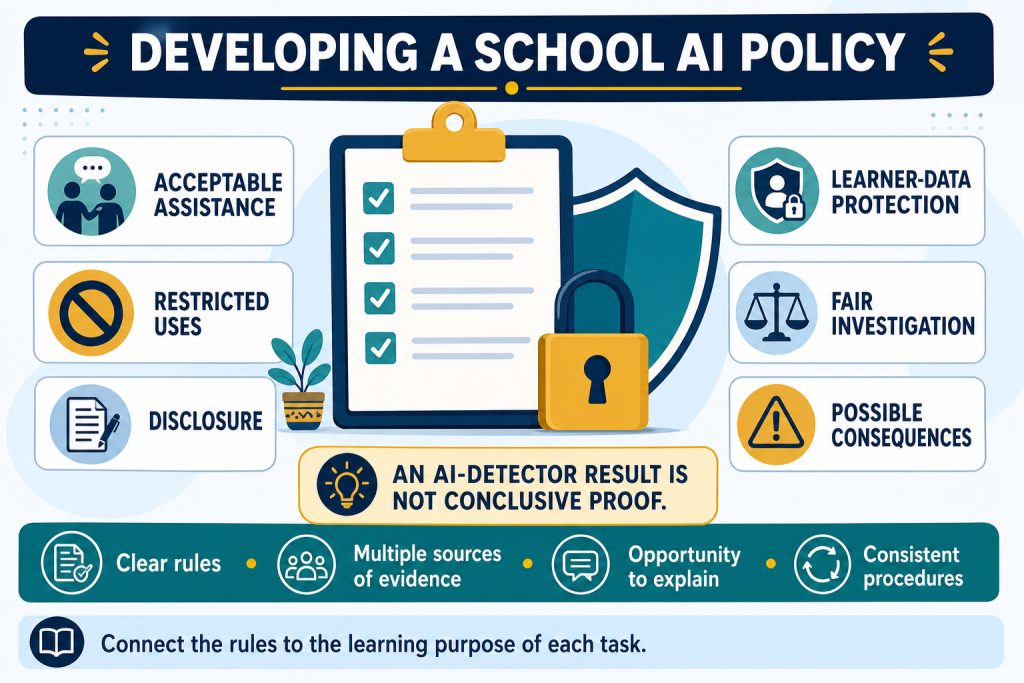
A practical school AI policy should explain acceptable assistance, restricted uses, disclosure requirements, learner-data protection, investigation procedures and possible consequences.
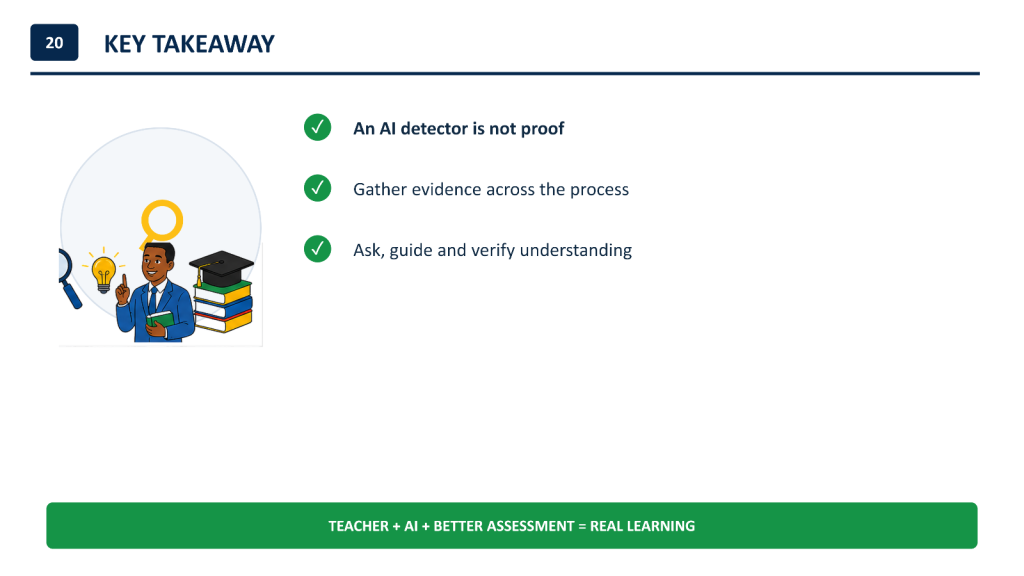
The policy should also make it clear that an AI-detector result is not conclusive proof.
Learners should have an opportunity to explain their work. Teachers should use multiple sources of evidence and apply procedures consistently.
The policy must be simple enough for learners, teachers and parents to understand. It should also recognise that different assessments require different rules.
AI assistance that is acceptable during brainstorming may be unacceptable during an examination or an assessment of independent writing.
The rules should therefore be connected to the learning purpose of each task.
The future is not teacher versus AI
Artificial intelligence will continue to improve. AI-generated writing will become more natural, personalised and difficult to distinguish from human writing.
Teachers should not respond by becoming suspicious of every polished assignment.
Instead, we should create learning activities in which thinking is visible. We should assess how learners research, select evidence, develop arguments, solve problems, revise work, explain decisions and apply knowledge.
AI may support parts of this process, but it should not replace the learner.
For me, the future is not teacher versus AI.
The more constructive future is:
Teacher + AI + better assessment.
The teacher remains responsible for professional judgement, context, fairness and the quality of learning.
Conclusion
Can teachers detect AI-generated assignments?
Teachers can sometimes identify warning signs. We can compare writing styles, verify references, examine drafts, ask questions and request practical demonstrations.
What we cannot do is treat an AI-detector percentage or personal suspicion as absolute proof.
Our response should be guided by fairness and the purpose of education. We should avoid immediate accusations, gather multiple forms of evidence, ask learners to explain their work and redesign assignments so that genuine understanding becomes visible.
The goal is not simply to catch learners using technology.
The goal is to ensure that technology does not replace the thinking, creativity, practice and understanding that education is intended to develop.Suggested final media: Insert the key-takeaway card stating that an AI detector is not proof, teachers should gather evidence across the process, and learners should be asked to explain